From Imagination to Canvas: The Art and Practice of Vincent Matthews VPSGFA FRSA

By any measure, Vincent Matthews is a maker of worlds. His paintings are alive with unexpected perspectives, architectural invention and an unmistakable thread of wit — scenes that feel both familiar and wonderfully strange. But behind these imaginative works lies a lifetime of drawing, observation, design expertise and an unwavering dedication to the craft.
Vincent worked for many years as a senior designer and Associate Director at Sibyl Colefax & John Fowler Ltd, producing hand-drawn sketches and interior concepts. Since completing a Contemporary Fine Art course in 2007, he has shifted his focus almost entirely to his fine art practice, with occasional architectural design projects woven in. Today, he is Vice President and Curator of the SGFA, a lifetime member of Pure Arts Group, and a recently appointed RSA Fellow. And on most days, you’ll still find him outside with a sketchbook in hand — a habit formed in childhood and sharpened over decades of looking closely at the world.
Drawing as Foundation
Vincents commitment to drawing is central to everything he creates
“I like to see the artist’s hand and personality in their artwork,” he says, “something honest — not a photograph, but evidence of the medium itself.”
He is an advocate for sketching from life, believing it creates a richer and more deeply felt connection to the subject. Observing in real space, he argues, develops sharper perception, embeds memory, and brings a narrative layer to the finished work that photographs simply cannot provide.
His mark-making is purposeful and expressive: hatching, cross-hatching, variations in line weight, and the careful use of white space give his drawings texture and vitality. It’s a lineage that echoes the past masters he admires — drawings that feel alive because the hand that made them is unmistakable.
Children, he believes, should learn to draw for this very reason: “It improves their observation, their understanding, and their ability to analyse what they see. It’s fundamental to creativity — even if they go on to use CAD in adult life.”
Tools, Materials and the Joy of Process
When sketching outdoors, Vincent favours pencil and ink paired with watercolour washes. For studio drawing, he turns to Indian ink and dip nibs — richer and more permanent than modern pigment liners, and full of character.
Oil painting, an early love from his teenage years, returned to him in earnest during and after the Covid lockdowns. By 2021 he found himself on a new trajectory: a surreal journey sparked in part by an online course with Pure Arts Group. His current body of work merges the structure of his design background with a liberated, playful imagination.
Painting the Unseen
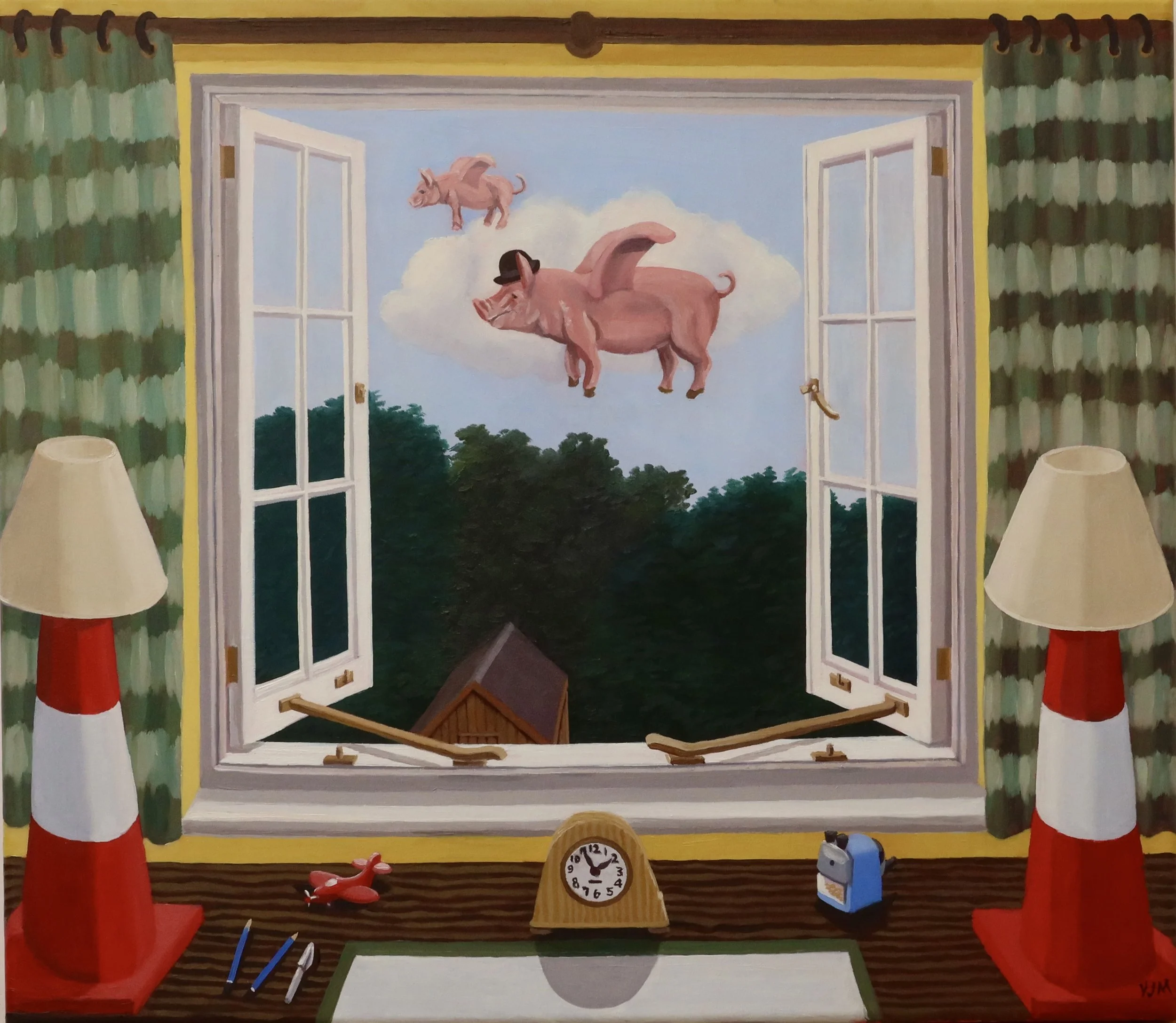
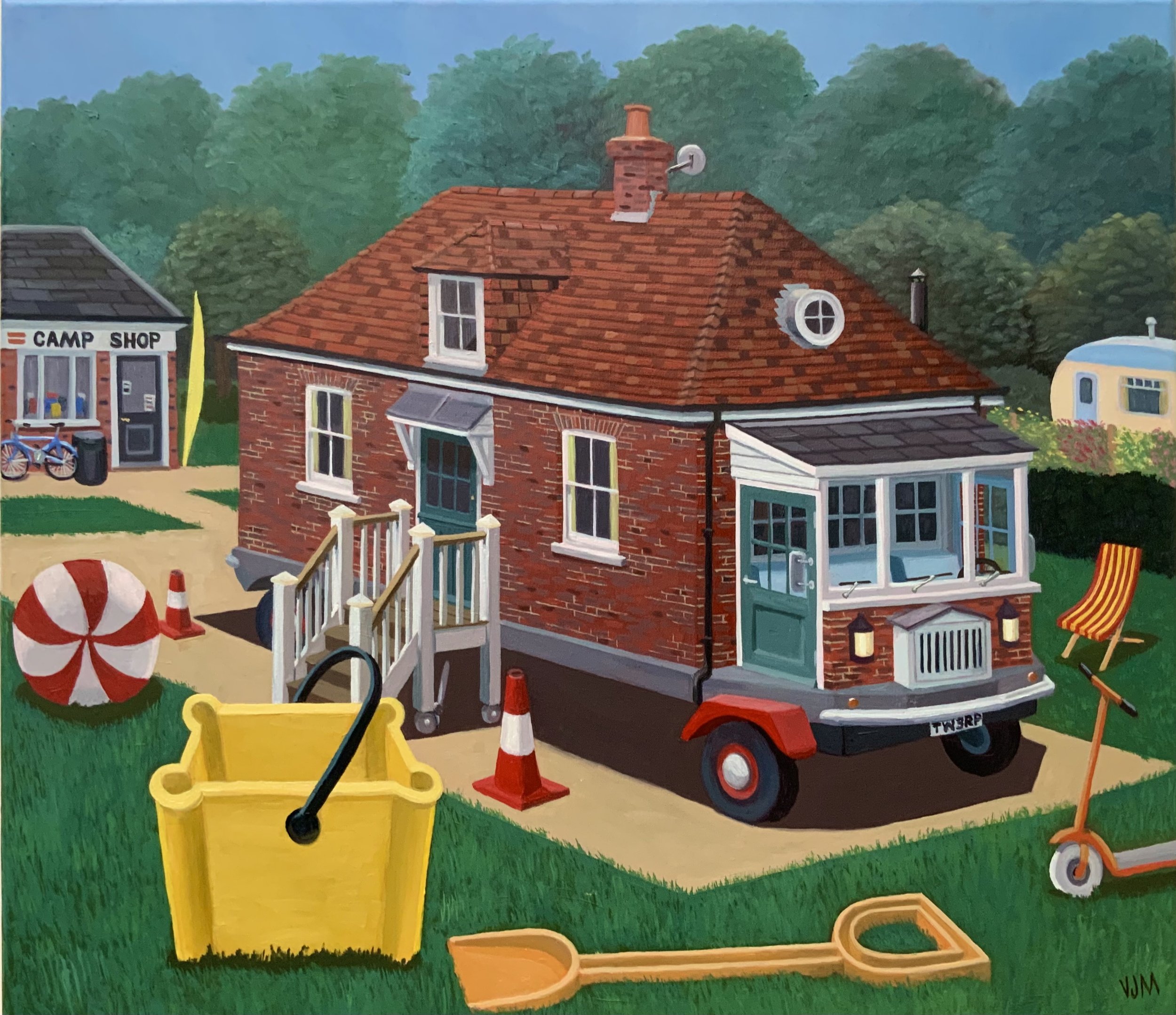
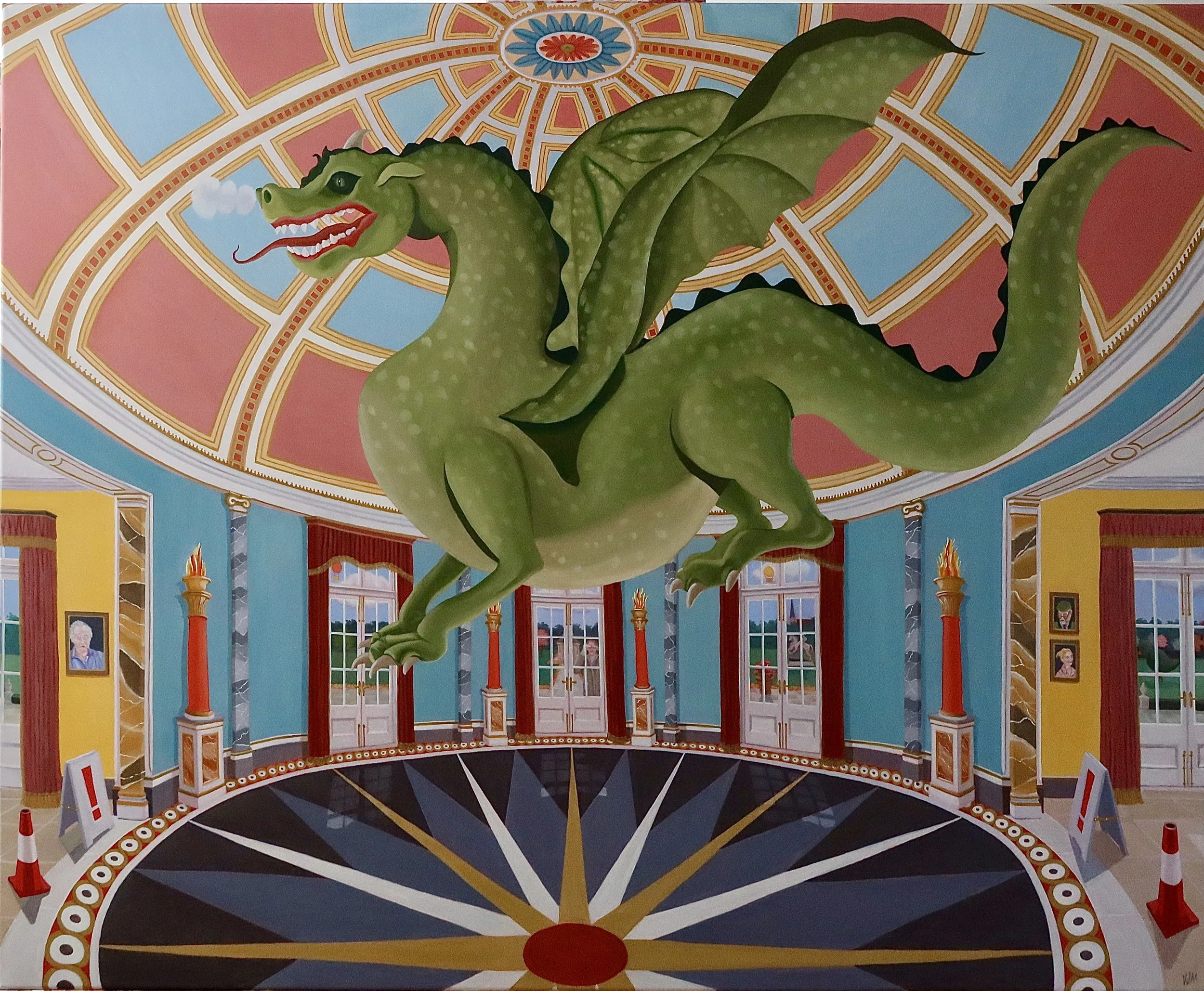
Vincents oil paintings do not depict real buildings, interiors or landscapes. Instead, they invent them.
“The buildings and furniture don’t exist in reality — they come out of my head,” he explains. “Years of drawing, observing, and detailing help me understand how things behave in space. That knowledge lets me bend the rules.”
Scale, perspective, and everyday objects collide in ways that recall Magritte — one of his major influences — alongside De Chirico, Carlo Crivelli, Hogarth’s storytelling and Hopper’s atmosphere. He also draws inspiration from the handcrafted charm of Terry Gilliam’s animations and the nostalgic quality of the Ladybird book illustrations he pored over as a child. Being severely deaf, Vincent learned to read late, relying instead on the visual world to make sense of things. Stories were something he saw before he ever read them — an early beginning to the narrative-driven paintings he creates today.
His process begins with a detailed compositional sketch, drawn onto the canvas in thinned paint. He then builds the work slowly in layers, mixing colour mostly from warm and cool primaries. Paintings are left to rest and revisited with fresh eyes, ensuring he never overworks the surface.
“It’s not a race,” he says. “I like the slower process. There’s a conversation with the painting.”
Ideas often arrive unexpectedly — during his morning dog walks, from the echo of a phrase, or from a fleeting observation that sparks a visual chain reaction.
Influences, Inspiration and Escapism
Vincents list of admired artists spans centuries: Turner, Ravilious, Singer Sargent, Rembrandt, Caravaggio, Cezanne, Gauguin, Dali — and many more. But his current creative compass points strongly toward Magritte, whose surreal juxtapositions and playful intelligence resonate deeply.
Yet Vincents imagination is also shaped by everyday life: a nostalgic affection for old cars, buses and trains; the character of historic buildings; memories of travel in Europe; a lifelong habit of reading on trains during his commuting years; and the humour and craftsmanship of British animation.
This imaginative practice offers not only creative satisfaction but also a form of escapism — a way to navigate the anxieties and pressures of modern life. In an age defined by global crises and relentless information, the act of inventing worlds becomes both refuge and release.
A Contemporary Approach with Human Roots
The contemporary fine art course he completed years ago introduced him to abstraction, the value of process, and the freedom of play. All now infuse his work. Even with a structured sketch at the outset, he deliberately leaves space for the painting to reveal itself along the way.
“It’s a journey,” he says simply.
Vincents paintings combine tradition with experimentation — meticulous observation blended with humour, imagination, and a distinctly human touch. His work challenges the viewer to participate, to form their own narrative, and to look beyond the obvious.
In an era dominated by high-definition photography and digital precision, his paintings celebrate something rarer: the inventive, imperfect, deeply personal world that can only come from the mind of the artist.
And for Vincent, that world is vast — and still expanding.
Summary
Vincent Matthews offers a compelling example of an artist who transformed from a detailed printmaker and interior designer into a creative explorer across ink, watercolour, print, and oil. His journey—from drawing before speech to holding leadership roles in SGFA—highlights the transformative potential of mark making, plein air practice, and imaginative oil painting. His work encourages all artists to trust their lines, experiment with media, and tell personal stories through art.
Further Viewing
Pure Arts interview: Lesley Samms discusses Vincent’s journey YouTube